Showing posts with label law. Show all posts

Monday, 27 May 2013

Industrial Sprawl and Crime Rates

The social and industrial growth of England during the Victorian period is generally well known, cottage industry and small mercantile ventures were replaced with industrialisation and manufacturing on a massive, and previously unprecedented, scale. The growth in employment opportunities in towns and cities prompted a mass exodus from rural areas into the rapidly industrialising towns. 

The social problem novel permeates the literary output of the Victorian period, whether a literary scholar or not, most people are familiar with at least one novel of the period which can be said to fall into the category of 'social problem' -from Oliver Twist to North and South the social condition of England as a result of industrialisation and urban expansion was firmly on the fore front of public consciousness.

By 1851 half of the population of Britain lived in towns, and by 1901 this had risen to 3/4, and it was this rapid growth which was considered the major cause of crime, as population density in cities caused the over crowding of slum areas and a concentration of poverty and subsistence living.  The anonymity and isolationist nature of sprawling slums precipitated and facilitated the rise of crime levels within the jurisdiction.  Without the careful scrutiny of a smaller, and more intimately acquainted, society these masses of the poor were inclined towards lawlessness and illegal behaviour - they were free of what was termed 'natural policing.' 

In 1852, M.D Hill (1792-1872), brother of Rowland Hill, the postal reformer, who had been a judge in Birmingham for 30 years, was examined by a House of Commons Committee on Juvenile crime and reported that:

A century and a half ago...there was scarcely a large town in this island...[by a] large town I mean [one]  where an inhabitant of the humbler classes is unknown to the majority of inhabitants...by a small town, I mean a town where...every inhabitant is more or less known to the mass of the people of the town...in small towns there must be a sort of natural police...operating upon the conduct of each individual who lives, as it were, under the public eye; but in a large town, he lives...in absolute obscurity...which to a certain extent gives impunity.

When this is viewed in light of the content of the social problem novel, we see it all but born out.  For example in Oliver Twist, we see a young man who's very name implies the operation of social determinism which will make him a criminal, the name Twist, referring to the hangman's noose which his namers believe he will ultimately meet, and when he is exposed to the slums of London, and their many inhabitants, he is capable of disappearing from his former masters and later being hidden from those friends who would seek to protect him from the criminal masses which are presented as thriving in those impoverished parts of the city.  
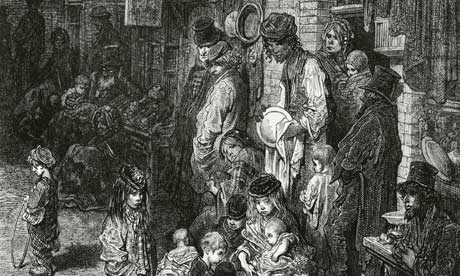
The social determinism, which Oliver overcomes with the revelation that his birth and parentage are not as abject as he had been led to believe, was considered a major motivation factor behind crime in urban London.  The poor, and ill educated, by virtue of their class of birth or parentage were more inclined than the wealthy towards acts of criminal behaviour because of the operation of biology and that it slum areas it was almost impossible to keep the honest poor from being exposed to the criminal poor, who were already acting upon their inborn, and here to fore, latent criminal proclivities, which their entire class possessed.  Andrew Mearns (1837- 1925) the chief author of The Bitter Cry of Outcast London: An Inquiry into the Condition of the Abject Poor(1883) wrote:

Few who will read these pages have any conception of what these pestilential human rookeries [the worst housing districts] are, where tens of thousands are crowded together amidst horrors which call to mind what we have learned...of the slave ship...One of the saddest results of this over-crowding is the inevitable association of honest people with criminals...Who can wonder that every evil flourishes in such hotbeds of vice and disease. 

As already mentioned, Contemporary analysts did not believe that it was poverty alone that caused crime, rather it was a motivating factor which allowed latent criminal tendencies to surface.  In the Report of the Royal Commission on a Constabulary Force [1839] the social reformer Edwin Chadwick wrote:

We have investigated the origin of the great mass of crime committed for the sake of property, and we find the whole ascribable to one common cause, namely, the temptations of the profit of a career of depredation [theft], as compared with the profits of honest and even well paid industry...the notion that any considerable proportion of the crimes against property are cased by blameless poverty...we find disproved at every step. 
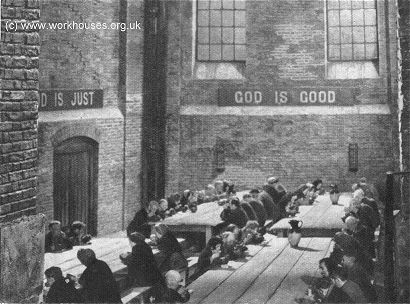

A narrow view, certainly, and an almost echoing, in tone, of Scrooge's interrogation of the charity workers demanding 'Are there no prisons, no poorhouses?' Assured in the expectation that the poor should voluntarily enter such places, but it was well known to Dickens, and his socially minded contemporaries, that these placed were often worse than the streets; with living conditions and hygiene so poor that death and
disease were rampant.  While these social institutions were in place to 'care' for the poor and prevent them from having to turn to crime as a means of survival, it should be noted that they might have been more honest, but they were certainly no safer.

Tuesday, 9 April 2013

Gin and Justice

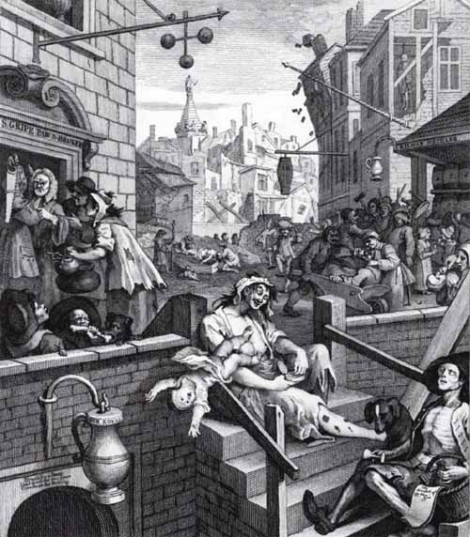
William Hogarth; Beer Lane and Gin Street

When one thinks of the underbelly of Victorian London the first thing that springs to mind is the image of the shadowy alleys of Whitechapel, where slum dwellers slink in gin soaked corners and their predilection for alcohol causing all sorts of criminal behaviour, as can been seen in this earlier image where the drunk and idling mother is allowing her child to fall from the steps in her stupor.  It was a condition of English poor life which
drew much contemporaneous attention, with critics such as William Hoyle in 1876 writing that alcohol had been responsible for turning England into a 'land of drunkenness, crime....[and]insanity.'  -

This was a view that was not entirely erroneous; the Reverend J.W Horsley (1845-1921), who had served as chaplain of the Clarkenwell Prison, London, engaged in an examination of the motivating and mitigating features of the criminal acts committed in his jurisdiction in his 1898 study Prisons and Prisoners.  He found that:

            ...half the cases of common assault, three-quarter of the assaults on the police and half the aggravated assaults were committed by drunken persons...Cruelty to animals...and children...of these, half might fairly be considered drink caused, as also might be half of the cases of malicious damage...and half of  such military and naval offenses...as come before the police courts...Then             [consider] the cases which are indirectly caused by drink, for example thefts     by or from drunken persons, and one arrives at the conclusion that half of all crime directly and an addition one-fourth as indirectly drink caused, is a moderate estimate...

Horsely argued, that while 170,000 people per year were charged with being drunken disorderly, there were other satellite crimes which were caused indirectly because of the consumption of alcohol or by people who were seeking access to alcohol.  He cited a number of case studies
            Stealing a pony and cart - a young man out on his employers business spends some of the money he has collected in a public house, and therefore fears to  face his master, recollecting the devil's proverb, 'As well be hung for the sheep as the lamb,' he sells the pony and cart.  As he expressed the matter to me, 'the  first word of your mouth when you're drunk is you don't care for nothing...

            Larceny-A married woman, aged 35, stole 30 shillings from her landlady to get drink...

            Begging- A woman, aged 44, seven out of ten children alive, her husband   fairly well to do, begged simply to get money for drink*. 


There is, of course, the argument that Horsley, as a leading temperance reformer, had an ulterior motive for blaming the condition of England's poor, and the high levels of criminal behaviour among (and involving) the Glasgow, consulting with police officers about the numbers of drunk individuals that were to be found on the streets of Glasgow in a given evening.  His study found that the average officer estimated that between 500-600 drunken individuals were to be found on Argyle Street, a major high street, on any given evening.  Over all, excesses of 9000 people in Glasgow were charged with drunk and disorderly behaviour, some in a condition of such stupor that they had been brought to the police station in wheel barrows. 
poorer classes on alcohol.  However, in 1858, a writer who called himself 'Shadow' wrote a study of

Despite the damning figures of Shadow and Horsley, the annual report of the Liverpool Head Constable for 1898 indicated that drunkenness was on the decline finding that:


  766 fewer cases of...drunk and riotous [behaviour] etc...Licensing Acts - the number of licenced-houses in the city had been decreased by 18 public houses and 2 beer-houses, and increased by 5 off-licenses...the number of licenced  premises...is:
            Public House: 1,865
            Beer House: 244
            Off-License: 153
            Total: 2,262

            Drunkness -
            The total number of arrests during the year: 4,292
            On a given night of the week:
            Sunday: 294
            Monday: 703
            Tuesday:544
            Wednesday: 452
            Thursday: 401
            Friday: 501
            Saturday: 1,398


This was a trend which was identified by the social critic Charles Booth, in his London based survey from 1902, which clearly identified that the number of arrests related to or involving alcohol were dropping as the new century progressed. 


*On  a side note, I find it interesting that the women both have the qualifying notes of being married and that one has a high number of living children, as though to state that these are otherwise 'good' women who have fallen low through the vice of alcohol- but that could be my personal hobby horse.  

Tuesday, 15 January 2013

Empirical Evidence in the Age of Empire


The Victorians valued empirical evidence in much the same way as it if valued today, as a way of measuring, dispassionately, an objective standard, ' what I want...' says Mr Gradgrind in Hard Times 'is facts.'  There was a prevalence, during the period, of the publication of statistics in magazines and periodicals for public consumption.  

There is a difficulty with these statistics because of the problems of ascertaining the truth behind them.  It is hypothesized that a significant portion of modern crimes go unreported, and statisticians posit that a significantly higher portion of Victorian crime also went unreported to the police.  One statistician posited that London crime statistics during the period are at least 50% higher than recorded.  

There is also the complex issue of identity, the number of individual offenders may well be lower than reported because of the extensive use of aliases.  The severe sentencing practices meant that many offenders went to great lengths not to be associated with their past misdeeds.  As Reverend J.W. Horsley noted in his 1887 book, Jottings from Jail:
            We take very little notice of names and ages in prison, as from various reasons they are apt to alter with each entrance.  Thus Frederick Lane, 15, has just been sentenced to 18 months imprisonment.  He has previously been in custody as Alfred Miller, 15, John Smith, 16, John Collins, 16, John Kate, 16, John Klythe, 17, John Keytes, 17.  

As the Quarterly Review 1874 found that:
...our readers in comparing the numbers of criminals in more recent years with those of an earlier period must...remember the additions which have been made to the population of the country.  The number of criminals is not much more than half in 1873. out of 23 millions of people, of what it was in 1841, out of 16 millions...In other words, whilst the growth of population has been nearly 45%, crime has actually diminished by about 25%. 

Frederick Engles (1820-95) blames the rise and expansion of the proletariat in industrial towns like Manchester and London for the rise in crime statistics from 1805 to 1842.  The Condition of the Working Class in England, (1844/45) by Engles, found that in 1805 there were 4,065 crime reported in England and Wales, but by 1842, 4,497 arrests were made in Lancashire alone, and 4,094 in Middlesex, including London.  The reported arrests for these two regions formed a quarter of the entire crime statistics for the country but their populations did not form a quarter of the entire population of England and Wales.  

However, from 1848 on-wards there was an almost year on year fall in those committed to penal custody, with the exception in 1854.  This fall is posited as the result of the higher level of police control during the period, their expanded powers and effectiveness facilitating a fall in penal sentences and crimes committed.   
Quarterly Review, October 1874
By 1840 the number of police officers employed by the Metropolitan Police force has risen to over 3,500 and police powers had been expanded inline with social needs, as the Judicial Statistics 1856-1873 reflects:
The commitments for trial in ...1856 show an unprecedented decrease...this must...be largely attributed to the extended powers of Justice of the Peace [i.e Magistrates] to deal summarily in cases of larceny under the Criminal Justice Act 1855.  

Tuesday, 5 June 2012

It's Almost Time...

I appreciate that it has been some time since last I made a post and to be honest it's entirely my own fault.  I've been working my butt off trying to get my first chapter...or rather technically second chapter completed and I guess this is more an update than a proper post.  I do promise a proper full length post on my dear A.C.D at some point in the near future.  

 I decided against writing my first chapter for a myriad of reasons but really it's because I felt that it would be easiest to write at the end of this process since it sort of chronicles the entirety of the Victorian period rather than a distinct idea as the rest of the chapters.  So the second chapter it was! It is an examination of the expression legal procedural ideologies in 3 Victorian novels.  I was a little iffy on it at the start but it really gathered pace and I think is a long over looked reading of the Victorian novel. 

The Chapter's title is an adaptive process, since the thrust of the argument has developed as I wrote it the original title of 'A Trying Situation: The Writer and the Legislative Process' no longer applies and I am searching for a new one -although it is proving more elusive than originally anticipated. 
 
To say that I was nervous about feedback was something of an understatement, I've been climbing the walls for three days over it, waiting for someone to tell me it's terrible that I really need to reconsider my life choices and that KFC is still hiring.  In the end however, it was no where near as bad as anticipated, in fact, it was really rather affirming, with my supervisor, who is a George Eliot specialist telling me that he found my argument excellent and my topic 'brilliantly unique.' *cue excited blush*  From him, at least, it's high praise, a bit like Andrea Bochelli telling you that you can sing.   

My chapter in the end is 18,000 words in length, which seems over long as I intended to make each chapter between 10-12,000.  It seems overlong but I have assurances from my supervisor that there is nothing he would remove and that the length issue will sort itself out as I write other chapters, since there is room for cross over which will facilitate trimming the fat later. 

So my confirmation of registration Viva is in a few weeks, the 25th of be precise and while my feedback has calmed me somewhat I am still as nervous as heck about it.  I anticipate spending the next fortnight like a rabid dog, killing dead things and with rapidly diminishing sanity and patience.  In final news I got my studentship, 18k a year to help my research, including a fee waiver and a £1,000 budget for conferences and academic facilities I might need.  Very excited by that!

Friday, 3 February 2012

Formalism and Beyond


Well my viva is over and complete so now it is time to crack on with the ‘real’ work –and not be distracted by little random things like writing a paper on doctor who *shifty eyes* but in the mean time I’m beginning my work on Felix Holt The Radical, it was a late addition to the texts that I’ve decided to include in the thesis and as such I am scrambling to read the 676 page text and the other late addition, Lady Audley’s Secret, while trying to do the theoretical research for the paper, which is really BORING.  I should point out that anything I write here is not a sample of my work, it’s largely unedited and pretty slovenly in it’s style and grammar…don’t like it …don’t read.

Now we begin with legal formalism- with a vague sort of Victorian slant. 

Ninteenth century formalism was a system which was ‘procedurally formalist to the extent that it makes the success of a substantive legal claim depend on following procedural rules (Schauer 1988).  This drew is primary legal principles from what is now known as primitive formalism was the practice of deciding the outcome of disputes through the use of oracles or through trial by battle, which, for obvious reasons, became regarded as irrational. 
            
This primitive formalism, is set in opposition to the Roman legal system of ‘strict law’, which was transposed into the English legal system in the medieval period in the form of ‘formulary law’ in which redress was only available if the case fell within a certain ‘class’ of cases.  It’s application in case law is closer to what we now considered as formulism.  
          
  It was not until the nineteenth century that ‘real’ legal formalism can be said to exist, as the century was marked by a movement beyond formulary justice but in a way that preserved the benefits of the previous systems.  The rise of legal formalism was complete by 1850, whereby the legal relationships seen as deriving from natural law and custom was supplanted by legal relationships forged through economic and political alliances, and substantive fairness, which was prevalent in eighteenth century legal discourse.  
            The idea of a paternalistic and regulative legal system, which extolled the legal obligations and moral sense of community was replaced by a system that was reflective of the power of economics and individual influence.  

            At it’s most basic level legal formalism is the degree to which the system is willing to sacrifice substantive justice (equity) in favour of a system which requires strict adherence to specific elements, that need to be in place before a case can be brought (von Jhering 1869) but is, by virtue of its construction, less irrational than the earlier Roman and Medieval structures.  

             Textual formalism is literalist in nature, whereby the meaning of an issue is not varied according to context.  The interpretation of legal cases in a formalistic manner requires that no reference or consideration be given to the intention or purpose of the parties and only the strict precedential or theoretical concepts that impact upon the case can be considered and applied in the decision making process.  

There are specific moral, political and practical considerations that impact upon the level of legal formalism that is applied within specific jurisdictions and while there is a valid argument for the application of a strictly formalistic approach to criminal justice, there is an even argument for a less formalistic approach on each counter point, the modern legal end-point would seem to be an ideal balance between the two, between moral justice and the principled application of legal process

Felix Holt and Formalism to follow....at some stage!

Citations and bibliography not posted but available on request.

Friday, 11 November 2011

The Means Justifying the Ends

At this stage of my PhD I am getting used to justifying my academic existence to those around me, people who question the exact purpose or meaning behind blue sky research like mine and while someone researching cancer may find it easy to explain to others why their research is important it is much harder for those of us who are engaged with topics of a slightly more esoteric nature. 

When a ‘layman’ reads the title of my project it immediately seems like something which should be an academic hobby rather than something upon which to pin a career.  For me a pithy title is still someway off but for those interested my research is focused around the idea that Victorian Novelists were influenced by the action of the legal system and the judicial decisions which made up the common law: and they expressed their opinions on that law through the themes and narrative of their novels.  I intend to examine to what extent were writers influenced by the actions of the court, where they got this information, what exactly were they were presented with, how they understood/interpreted that action and it’s accuracy, what their interpretation portrays of their opinions on the legislative/common law changes,  and did this tally with/run counter to public opinion?...This is usually around the time people are sorry that they asked. 

I am sure many are wondering what the heck relevance that could possibly have –old books are antiquarian curiosities and old law is largely irrelevant but I am inclined to disagree.  Law, like much of literature, is contextual and it is my conjecture that one feeds into the context of the other.  The law is a social barometer of sorts and a society is defined by that which it criminalises and marginalises, so a novel which purports to reflect a given society must take into account the rules which bind the lives of the characters.  I will spare the blog audience an in-depth analysis of this for the moment because for the present the conclusion rather than the process through which I came by it is important. 

At this stage most people say ‘Well that’s all well and good, it’s even interesting but it is still merely blue sky content and is largely useless!’  However, what I intend to present is an examination of how the writers perceived the law, it’s interpretations, and how far these were correct because it is all well and good having righteous legal intentions created in the best interests of the people but if the perception or operation of legislative and common law are not in line with this then the legislative begins to loose touch with those who it intends to protect. 

If a cogent argument can be made of the interaction between the law and literary expression 100 years ago then now, in an age of greater social awareness this interaction may still hold true.  In which case both legislative and judicial bodies may be able to observe the way in which their judicial opinions and legislative decisions are expressed and interpreted by the masses who live with them through modern literature. 
This is generally the point when people ask why I am using Victorian Literature to create the connection rather than modern texts if my final assertion is that modern texts speak to the operation of the legal system.  Well in the words of Julie Andrews ‘Let's start at the very beginning A very good place to start When you read you begin with A-B-C’ and the Victorian period was a time of massive legal upheaval in which arguably the modern legal system was born and in order to ascertain the connections depth it would seem a good idea to go back to a time when the common persons legal interactions were limited and their knowledge of the system was more limited again but increased standards of education meant that access to newspapers, books and early forms of ‘mass media’ were on the rise. 

If the connection I purport to prove is present then, then now, when mass media assists the common man in understanding the effect of legislative decisions on his life, it should be a much more straight forward connection to make. 

Well! That’s the theory anyway. 


Courtesy of PhD


Friday, 23 September 2011

Not Quiet Nancy: Modern Prostitution

Crime and the law are not stable entities; rather they are constantly in flux, evolving with and around a society, for example in times of economic crisis, when employment goes down the prison population goes up.  This is not necessarily because there are more criminals but rather because there is an ‘ideologically motivated response to a growing number of financially marginalised people.’(Hale et al. in McLaughlin and Muncie P96) Society fears the actions of the potentially desperate and so issues a ‘pre-emptive’ strike against crime by increasing the severity of sentences. 

In most societies however, crime is something which is outlawed by the state, these laws are made by the most powerful people in any given society and seldom properly protect the weak.  Most notably, Prostitution laws are mostly made to stop prostitutes rather that those who solicit them or to address the factors which have caused these women to turn to prostitution.  The critic Barbara Hudson points out ‘that crimes against the weak seldom get as far the criminal justice system, they are undiscovered, unreported, un-investigated, unresolved, unprosecuted and in the end forgotten.’  (Hudson 2009 lecture) 

One area of feminine crime which has not changed that much with the passage of time is prostitution.  It has strongly resisted any and all attempts at reform in the UK and Ireland on the basis that while society’s general make up may alter Christian values still hold sway and religion itself tends towards a patriarchal stand point.  I have not the space here to do justice to the topic nor to give sufficient depth of analysis but it is true that in many patriarchal societies the only thing of value that a woman had to sell was her physical form.  From Irish Brehon law, which saw prostitutes as less than people and void of an honour price, to the Victorian period were prostitution itself was illegal, but generally overlooked.  It was only when these outcast and despised members of society were accused of being disorderly or ‘nuisance prostitutes’ that they felt the force of the legislation or criminal proceedings. 

                Little or none of the legislation which was introduced to govern prostitution was made to deal with those who utilised prostitutes, which were mostly men.  Pat Carlen argues that this was largely due to the fact that male sexual acts had few visible results, the man bore no outward sign of the ‘disgrace’ associated with the using prostitutes while ‘[w]omen’s sexual misdemeanours’ often resulted in pregnancy (Carlen, 1983 P28)

In much the same way in which the Contagious Diseases Act 1864-1869 made women bear the blame for the spread of sexual disease but did nothing to deter the men that used prostitutes.  Women could be harassed and imprisoned in hospitals on suspicion of having a sexually transmitted disease while the men who through the use of multiple prostitutes and sexual partners bore none of the responsibility.  Indeed there were critics at the time who claimed that the Act did nothing but encourage the use of prostitutes as it ensured that the women who did sell their bodies were ‘safer’ as they were more likely to be free of infection.  The nurse Florence Nightingale was one of many women who signed the ‘Women’s Protest’, which was eventually resulted in the repeal of the Act in 1886. 


Bibliography Available

Getting Serious!

Okay! So I have been keeping a vague sort of thing on the go for ages now and thought it best to composite it all in one place and make it all a bit more focused - after all I have started my Phd which is all about Victorian law and it's affect on the literature of the age.  So I get to spend the next few years up to my eyes in the worst travesties of the Victorian legal system and lots of books - great right!?


The literature in question is a lot of the stuff you might expect really -Sherlock Holmes, Wilkie Collins, even a bit of Dickens for the civil law stuff.  I would have tried to cram in a bit of Poe but it might have been a touch too ambitious since the general focus is the operation of the UK legal system rather than the US one- although I am still in two minds over the inclusion of some traditionally 'Irish' Victorian writers since it was pre-1921 and as such they would have been subject to English law and as such fall under the auspices of the researches wider umbrella.

To say that it's not motivated by an overwhelming desire to hide from the job market while getting to read Sherlock Holmes over and over again and the rest of the canon of early detective fiction.  I might also be something of a creep for looking forward to trawling through the rather florid articles in The Illustrated Police News and the like - they shouldn't be amusing because they are depictions of actual events and incidents involving real people but the little drawings are so overly dramatic that I can't help but smirk at them.

Basically the purpose of this blog will be largely the same as the old postings but with a bit more focus, Ill be throwing things up that relate to Victorian law, Victorian literature or any sort of related bits and pieces that take my fancy - so it won't be changing that much just with a little more focus than before.  Granted I still might go off on tangents and post random things that seems totally unrelated, the truth is that they might well be but they have taken my fancy or have been sparked by some crazy thought process relating to my research.  So here we go!

Thursday, 22 September 2011

Five Daughters

I recently watched the BBC mini series ‘Five Daughters’.  I'd seen it before but while taking a well deserved disertation break I managed to catch it a second time when I could give it my full attention. 


‘Five Daughters’ is the stories of the Anneli Alderton, Paula Clennell, Gemma Adams, Tania Nicol and Annette Nicholls, the victims of Steven Wright, dubbed in the media ‘The Suffolk Stranger.’  It follows the last few days of these women’s lives as they try to protect themselves and come to terms with the death of their friends. 

When the series originally aired, I like many people, was concerned and angry as to how the events and the people involved would be treated in the serial and I originally refused to watch.   The media in general place their emphasis on those who commit the crimes rather than the victims – most people can recognise the names or the faces of Myra Hindley, Ted Bundy, Jack the Ripper, John Wayne Gacy, but few would recognise the names of Janice Ann Ott, John Kilbride, Elizabeth Stride, and Darrell Sampson as their victims.  We are presented with headlines and pictures of the criminals looking callous or insane, with scant mention of the victims unless it is to point out how their lifestyle got them into trouble, as with Peter Sutcliffe victims, or how their lifestyle or age makes them even more pitiable. 

I admit now that my reservations were merely presuppositions on my part and I was entirely incorrect in what the scope of the show actually was.  It wasn’t a slasher movie; it didn’t portray Wright as a mythic Jack the Ripper type killer, indeed the actor playing himself was only on screen for about three minutes at the end. 

It instead, focused on the human tragedy of the events of October to December 2006 and the relationships of these women with each other, their families, and the police.  It was impressive that director Phillipa Lowthorpe, writer Stephen Butchard, and the BBC did not give in to the temptation to create a CSI/Silent Witness style show which I think would have diminished the series. 

Instead, the approach was sensitive and Natalie Press, Eva Birthistle, Jaime Winstone, and Aisling Loftus portrayed the girls as real people with real problems not as preconceived stereotypes of the fallen woman or as pretty woman parodies of their lifestyle.  It seemed a candid view of the victims lives. 

The victim centric approach is such a change from the normal series of this genre and the emphasis on the human tragedy rather than the morbid fascination in their deaths helps to diminish the cult of notoriety that often attaches itself to people like Wright.  Well done BBC, in a genre where it is all too easy to forget the victims they’ve done a great job in focussing on the people who were really affected by the events of October – December 2006

EDIT!
I'd also like to add that the program that helped many of the street workers in Ipswich in the wake of the murders is on the brink of closure.  Help Save the ICENI - Sign the PETITION

If you've been affected by anything relating to the series please take a look at the BBC support site - HELP