The social and industrial growth of England during the
Victorian period is generally well known, cottage industry and small mercantile
ventures were replaced with industrialisation and manufacturing on a massive,
and previously unprecedented, scale. The growth in employment opportunities in
towns and cities prompted a mass exodus from rural areas into the rapidly
industrialising towns.
The social problem novel permeates the literary output of
the Victorian period, whether a literary scholar or not, most people are
familiar with at least one novel of the period which can be said to fall into
the category of 'social problem' -from Oliver Twist to North and South the
social condition of England as a result of industrialisation and urban
expansion was firmly on the fore front of public consciousness.

By 1851 half of the population of Britain lived in towns, and by 1901
this had risen to 3/4, and it was this rapid growth which was considered the
major cause of crime, as population density in cities caused the over crowding
of slum areas and a concentration of poverty and subsistence living. The anonymity and isolationist nature of
sprawling slums precipitated and facilitated the rise of crime levels within
the jurisdiction. Without the careful
scrutiny of a smaller, and more intimately acquainted, society these masses of
the poor were inclined towards lawlessness and illegal behaviour - they were
free of what was termed 'natural policing.'
In 1852, M.D Hill (1792-1872), brother of Rowland Hill, the
postal reformer, who had been a judge in Birmingham for 30 years, was examined
by a House of Commons Committee on Juvenile crime and reported that:
A century and a half
ago...there was scarcely a large town in this island...[by a] large town I mean
[one] where an inhabitant of the humbler
classes is unknown to the majority of inhabitants...by a small town, I mean a
town where...every inhabitant is more or less known to the mass of the people
of the town...in small towns there must be a sort of natural police...operating
upon the conduct of each individual who lives, as it were, under the public
eye; but in a large town, he lives...in absolute obscurity...which to a certain
extent gives impunity.
When this is viewed in light of the content of the social
problem novel, we see it all but born out.
For example in Oliver Twist, we see a young man who's very name implies
the operation of social determinism which will make him a criminal, the name
Twist, referring to the hangman's noose which his namers believe he will
ultimately meet, and when he is exposed to the slums of London, and their many
inhabitants, he is capable of disappearing from his former masters and later
being hidden from those friends who would seek to protect him from the criminal
masses which are presented as thriving in those impoverished parts of the
city.
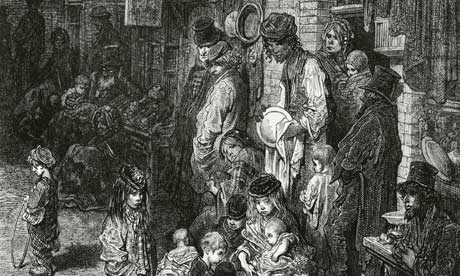 The social determinism, which Oliver overcomes with the
revelation that his birth and parentage are not as abject as he had been led to
believe, was considered a major motivation factor behind crime in urban
The social determinism, which Oliver overcomes with the
revelation that his birth and parentage are not as abject as he had been led to
believe, was considered a major motivation factor behind crime in urban
Few who will read
these pages have any conception of what these pestilential human rookeries [the
worst housing districts] are, where tens of thousands are crowded together amidst
horrors which call to mind what we have learned...of the slave ship...One of
the saddest results of this over-crowding is the inevitable association of
honest people with criminals...Who can wonder that every evil flourishes in
such hotbeds of vice and disease.
As already mentioned, Contemporary analysts did not believe
that it was poverty alone that caused crime, rather it was a motivating factor
which allowed latent criminal tendencies to surface. In the Report
of the Royal Commission on a Constabulary Force [1839] the social reformer
Edwin Chadwick wrote:
We have investigated
the origin of the great mass of crime committed for the sake of property, and
we find the whole ascribable to one common cause, namely, the temptations of
the profit of a career of depredation [theft], as compared with the profits of
honest and even well paid industry...the notion that any considerable
proportion of the crimes against property are cased by blameless poverty...we
find disproved at every step.
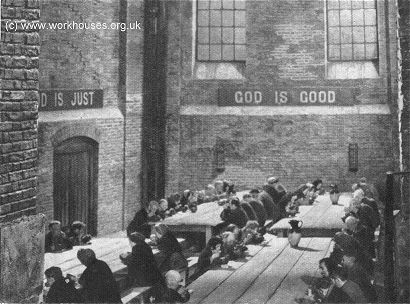 A narrow view, certainly, and an almost echoing, in tone, of
Scrooge's interrogation of the charity workers demanding 'Are there no prisons,
no poorhouses?' Assured in the expectation that the poor should voluntarily
enter such places, but it was well known to Dickens, and his socially minded
contemporaries, that these placed were often worse than the streets; with
living conditions and hygiene so poor that death and
A narrow view, certainly, and an almost echoing, in tone, of
Scrooge's interrogation of the charity workers demanding 'Are there no prisons,
no poorhouses?' Assured in the expectation that the poor should voluntarily
enter such places, but it was well known to Dickens, and his socially minded
contemporaries, that these placed were often worse than the streets; with
living conditions and hygiene so poor that death and