Showing posts with label criminal features. Show all posts

Tuesday, 9 April 2013

Gin and Justice

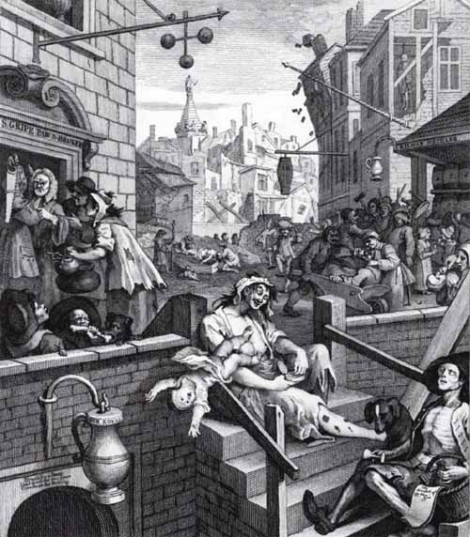
William Hogarth; Beer Lane and Gin Street

When one thinks of the underbelly of Victorian London the first thing that springs to mind is the image of the shadowy alleys of Whitechapel, where slum dwellers slink in gin soaked corners and their predilection for alcohol causing all sorts of criminal behaviour, as can been seen in this earlier image where the drunk and idling mother is allowing her child to fall from the steps in her stupor.  It was a condition of English poor life which
drew much contemporaneous attention, with critics such as William Hoyle in 1876 writing that alcohol had been responsible for turning England into a 'land of drunkenness, crime....[and]insanity.'  -

This was a view that was not entirely erroneous; the Reverend J.W Horsley (1845-1921), who had served as chaplain of the Clarkenwell Prison, London, engaged in an examination of the motivating and mitigating features of the criminal acts committed in his jurisdiction in his 1898 study Prisons and Prisoners.  He found that:

            ...half the cases of common assault, three-quarter of the assaults on the police and half the aggravated assaults were committed by drunken persons...Cruelty to animals...and children...of these, half might fairly be considered drink caused, as also might be half of the cases of malicious damage...and half of  such military and naval offenses...as come before the police courts...Then             [consider] the cases which are indirectly caused by drink, for example thefts     by or from drunken persons, and one arrives at the conclusion that half of all crime directly and an addition one-fourth as indirectly drink caused, is a moderate estimate...

Horsely argued, that while 170,000 people per year were charged with being drunken disorderly, there were other satellite crimes which were caused indirectly because of the consumption of alcohol or by people who were seeking access to alcohol.  He cited a number of case studies
            Stealing a pony and cart - a young man out on his employers business spends some of the money he has collected in a public house, and therefore fears to  face his master, recollecting the devil's proverb, 'As well be hung for the sheep as the lamb,' he sells the pony and cart.  As he expressed the matter to me, 'the  first word of your mouth when you're drunk is you don't care for nothing...

            Larceny-A married woman, aged 35, stole 30 shillings from her landlady to get drink...

            Begging- A woman, aged 44, seven out of ten children alive, her husband   fairly well to do, begged simply to get money for drink*. 


There is, of course, the argument that Horsley, as a leading temperance reformer, had an ulterior motive for blaming the condition of England's poor, and the high levels of criminal behaviour among (and involving) the Glasgow, consulting with police officers about the numbers of drunk individuals that were to be found on the streets of Glasgow in a given evening.  His study found that the average officer estimated that between 500-600 drunken individuals were to be found on Argyle Street, a major high street, on any given evening.  Over all, excesses of 9000 people in Glasgow were charged with drunk and disorderly behaviour, some in a condition of such stupor that they had been brought to the police station in wheel barrows. 
poorer classes on alcohol.  However, in 1858, a writer who called himself 'Shadow' wrote a study of

Despite the damning figures of Shadow and Horsley, the annual report of the Liverpool Head Constable for 1898 indicated that drunkenness was on the decline finding that:


  766 fewer cases of...drunk and riotous [behaviour] etc...Licensing Acts - the number of licenced-houses in the city had been decreased by 18 public houses and 2 beer-houses, and increased by 5 off-licenses...the number of licenced  premises...is:
            Public House: 1,865
            Beer House: 244
            Off-License: 153
            Total: 2,262

            Drunkness -
            The total number of arrests during the year: 4,292
            On a given night of the week:
            Sunday: 294
            Monday: 703
            Tuesday:544
            Wednesday: 452
            Thursday: 401
            Friday: 501
            Saturday: 1,398


This was a trend which was identified by the social critic Charles Booth, in his London based survey from 1902, which clearly identified that the number of arrests related to or involving alcohol were dropping as the new century progressed. 


*On  a side note, I find it interesting that the women both have the qualifying notes of being married and that one has a high number of living children, as though to state that these are otherwise 'good' women who have fallen low through the vice of alcohol- but that could be my personal hobby horse.  

Wednesday, 4 July 2012

The Criminal Female

I have spent the time since the Viva pouring over a text from 1895,  The Female Offender, by Professor Caesar Lombroso, part of the Criminology Series published T. Fisher of London.  I stumbled upon it in the Library, I believe it’s an original and I am pretty sure it should be in short loan not full loan, since I now have it until October.

The introduction, written by W. Douglas Morrison, expresses the surety that Lombroso’s study of criminal anatomy will shed light on what creates and defines an offender and allow the penal system to better administer justice.  I find it incredibly interesting that in an introduction to a ‘scientific’ text about the physical deformities of female offenders, Morrison manages to make it through the entire introduction only mentioning female offenders once.

Morrison does however point out the rather interesting statistic that in the US, in 1850, 6,737 (1:3,442) people were housed in prison accommodation for a variety of reasons, by 1890 this number had swelled to 82,329, (1:757) and this increased was described contemporaneously as ‘a tide that has no ebb.’  A huge increase by anyone’s standards, although nothing to today’s US prison population.

Lombroso’s study examined a number of races and nationalities, with some measure of outsourcing of the post mortem examinations to various countries.   The monograph upon which the entire 620 page study is founded studied the anatomy of:

  • 26 skulls and 5 skeletons in the possession of Signor Scarenzi  (All prostitutes)
  • 60 subjects who died in a prison in Turin, examined by Messrs. Varaglia and Silva
  • 17 in Rome, examined by Mingazzini and Ardú

Constituting

  • 4 Prostitutes
  • 20 Infantacides
  • 2 Complicity in Rape
  • 14 theft 
  • 3 Arson
  • 4 Wounding
  • 10 Assassins 
  • 1 Abortion

On a purely curiosity basis I want to know the measure of their definition of ‘assassin’.
Anyway!

For Lombroso physical deformity and criminality walk hand in hand, he identifies deformities in the face and skull and equates those with criminal behaviours, drawing connections between specific deformities, their prevalence in woman, as opposed to men, and the sorts of crimes committed by women with specific deformities.

Lombroso posits that the number of cranial anomalies present in a skull indicates a propensity towards criminal behaviours and that the number of anomalies can determine the type of crime that those women were predisposed to.  His observation that male criminals had a higher number of anomalies would seem to lead to the suggestion that it takes fewer abnormalities to turn a woman into a criminal than it does a man.

Lombroso’s work was, in effect, a method of using the physicality of women against them, women who suffered from genetic deformities, or who were simply unprepossessing were criminalised because of their appearance and any lack of feminine grace they might have possessed with hairy moles ‘marking degeneration in the female subject.’  It is hard to believe now that this was ever considered science, logic would dictate that when examining a woman in her 60’s that wrinkles would be a sign of ageing rather than her moral degeneration.  Taken in isolation, you could be forgiven for thinking they were describing a Disney witch rather than an attempt to 'scientifically' render the female criminal's features.  

He cites the case of Maria Köster who killed her mother with a hatchet – Lombroso posits that her facial asymmetry and asymmetrical pupil was indicative of her predisposition.  He identified a large number of ‘features’ of the female criminal, from projecting ears, flat nose, to ‘Mongolian features’ – an expression of casual racism which is hardly surprising when an examination of the plates provided in the book show several woman who bear obvious features of being mixed race.

However, while the work incites nothing short of horror in me, as a modern reader, the work makes the acceptances that ‘a man suffering from an attack of typhoid fever cannot be subjected to the same dietary, to the same exercise, as another person in the enjoyment of ordinary health.  The regime to which a patient is subjected must be suited to the anomalous condition in which he happens to be placed.  Criminal codes to be effective must act upon precisely the same principle,’ This is one of the first times, in my reading, that I have seen any sort of acknowledgement made of the adaptive nature of criminal penal administration. While it is not aimed at women, this acceptance would seem to be a first step towards the acceptance of the unique judicial position of criminal women.


Reading through the description of the degenerate female I was disconcerted to see that I fit the mould of more than one, I am of ‘unusual short stature’, ‘gigantic canine’,  deep set eyes’, with ‘prehensile feet’, and ‘very black hair’…so all in all…it’s a wonder I haven’t killed more than one person by now.